
Call Anytime
Call Anytime
+1 (707) 379-9110
If you have a 2-year conditional green card, you must file Form I-751 to become a permanent resident without conditions. Miss the window and your status is at risk. We manage the entire joint petition — evidence review, form preparation, and filing — with an assigned case manager.
✓ Free assessment (valued at $80) — no payment to book.
✓ Honest evaluation: if your case needs a lawyer, we'll tell you.
Quick Step is not a law firm. We provide professional document management and case support services, not legal advice.
If you received your green card through marriage and had been married less than two years when it was approved, USCIS issued you a CONDITIONAL green card valid for exactly 2 years. It cannot be renewed.
Removal of conditions is the process of proving your marriage was genuine so USCIS replaces that conditional card with a standard 10-year permanent resident card. You do it by filing Form I-751, Petition to Remove Conditions on Residence.
This is not a renewal. Form I-90 — the form used to renew a 10-year green card — does not apply to conditional cards.
Filing the wrong form costs you months.
You must file during the 90 days immediately before your conditional green card expires. Not earlier, not later.
File too early and USCIS rejects the petition and returns it. File late and your conditional status terminates — you lose work authorization
and can be placed in removal proceedings.
Check the expiration date on the front of your card and count back 90 days. That is the day your window opens.
If your card already expired and you have not filed, act immediately. Late filing is possible with a written explanation of good cause, but
USCIS decides case by case.
✓ Free assessment (valued at $80) — no payment to book.
We handle joint petitions: married couples still together who file Form I-751 as a team. That is an administrative filing, and we do it well.
✅ We can help you if:
❌ You need an immigration attorney if:
Those cases require a waiver of the joint filing requirement. The legal strategy matters as much as the paperwork, and getting it wrong can put your status at risk — that is attorney work, not case management.
If your case falls in that group, we will tell you during your free validation appointment and point you toward qualified legal counsel. We would rather lose a client than mishandle a case like yours.
This is what separates an approved I-751 from a Request for Evidence. USCIS wants proof that you built a life together, not just a marriage certificate. The strongest petitions combine three types:
Quantity is not the goal — coverage is. Evidence spanning the entire two years across all three categories beats a thick folder covering one month. Your case manager tells you exactly what is missing before anything is filed.
The total cost has two parts: the USCIS filing fee paid to the government, and the professional service fee if you choose managed filing.
USCIS filing fee: $700 online / $750 by paper
Quick Step professional service: $750 flat
Current USCIS processing time for Form I-751 ranges from 18 to 40 months, depending on your service center. That is one of the longest waits in the immigration system — and it is exactly why filing correctly the first time matters so much.
When USCIS receives your petition, it sends an I-797 receipt notice that extends your conditional green card validity. Carry that notice with your expired card as proof of status for employment verification and travel.
A Request for Evidence caused by weak or inconsistent documentation adds months on top of an already lengthy timeline. With waits this long, you cannot afford an RFE.
→ Check current USCIS processing times
→ See our processing times guide
Filing Form I-751 yourself seems simple — until USCIS sends a Request for Evidence because of a technical error or thin documentation. Our managed process is designed to eliminate that risk.
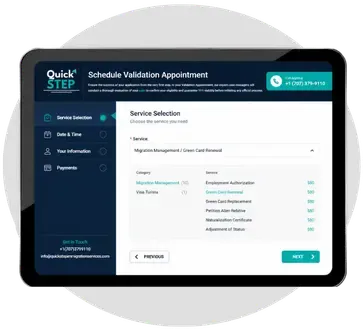
Choose your date and time online. No payment required to book.

A professional case manager reviews your case in a 30-min call and tells you honestly whether it’s viable.
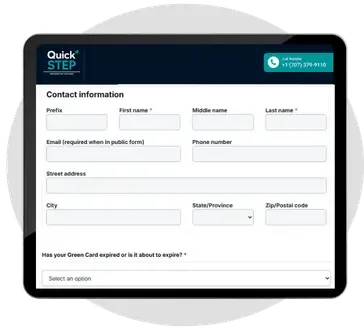
If your case is viable, pick the plan that works for you: pay in full (10% off) or split it 50/50.
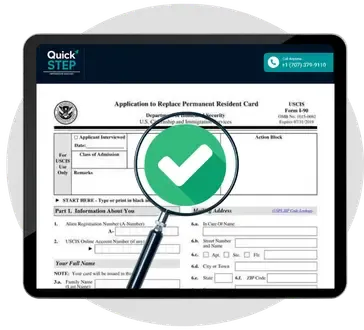
Fill out your form inside our CRM with direct human support.
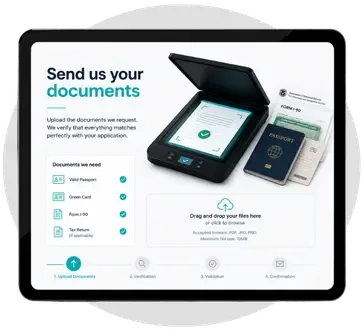
Your case manager audits every field; you upload the documents we request. No RFEs, no delays.

We submit your case and handle every USCIS notice until your new card arrives.
✓ Free assessment (valued at $80) — no payment to book.
Every I-751 petition at Quick Step is handled by a dedicated Immigration Case Manager — a document specialist trained in USCIS filing requirements, not a chatbot and not a generic call center.
Your case manager builds your evidence checklist, reviews every document you send, cross-checks the petition against your evidence before filing, and monitors your case until your 10-year card arrives.
We are not a law firm. For joint petitions that is exactly what you need: precision, not litigation. For anything else, we tell you honestly and
point you to an attorney.
Confusing these two cards is the single most expensive mistake a conditional resident can make. They look almost identical, but they require different forms, different deadlines, and different evidence — and filing the wrong one means starting over months later.
Here is how they compare side by side:
| Conditional (2-year) | Permanent (10-year) | |
|---|---|---|
Form to file |
I-751 (remove conditions) |
I-90 (renew or replace) |
Validity |
Exactly 2 years — cannot be renewed |
10 years — renewable |
Filing window |
90 days before expiration |
Within 6 months of expiration |
What you prove |
A bona fide marriage |
Your identity and status |
If you miss it |
Status terminates; removal risk |
Status intact; card invalid |
Next step |
→ You are on the right page |
Immigration fraud targets people at their most vulnerable moment. Before you pay anyone — including us — verify these five things:
Immigration fraud targets people at their most vulnerable moment. Before you pay anyone — including us — verify these five things:
If a provider fails any of these, walk away. Report immigration fraud to the FTC, and check the official USCIS scam prevention guide.
→ Report fraud to the FTC (https://reportfraud.ftc.gov/)
→ USCIS: Avoid Scams (https://www.uscis.gov/scam)
Don't risk a status lapse or an RFE that adds months to an already long wait. Book your free validation appointment — a case manager reviews your case and tells you honestly whether we can help, before you pay anything.

+1 (707) 379 9110
Send email
info@quickstepimmigrationservices.com
100 Se 2nd St, Suite 2000, Miami
Removing conditions on a green card raises a lot of questions — about timing, evidence, cost, and what happens if something goes wrong. Here are direct answers to the ones our case managers hear most, with the 2026 figures you need to plan your filing.
A temporary green card — officially called a conditional green card — requires filing Form I-751, Petition to Remove Conditions on Residence. You file jointly with your spouse during the 90 days before your 2-year card expires, along with evidence that your marriage is genuine. Once approved, USCIS issues a standard 10-year permanent resident card.
There are five steps: confirm your 90-day filing window, gather evidence proving a bona fide marriage, complete Form I-751 with your spouse, file with USCIS and pay the filing fee, then attend biometrics if required. Most denials and delays come from weak evidence, not from the form itself.
Removing conditions costs $750 in USCIS filing fees for paper filings, or $700 if you file online. Add our professional service fee of $750, with two payment plans: pay in full after your validation appointment for 10% off ($675), or split it into two payments of $375 — half to start and half before we file with USCIS. An immigration attorney typically charges two to three times that for the same joint petition. No hourly billing, no hidden charges.
USCIS does not want a document list — it wants evidence that you built a life together. The strongest petitions combine financial records (joint tax returns, shared accounts), residence proof (lease or mortgage with both names, utility bills), and family evidence (children's birth certificates, photos across both years, affidavits). Coverage across the full two years matters more than volume.
No. If you are divorced, separated, widowed, or your marriage involved abuse, your case requires a waiver of the joint filing requirement — and that needs an immigration attorney, not a case manager. We handle joint petitions only, and we will tell you honestly during your free validation appointment if your case falls outside that scope.
You must file during the 90 days immediately before your conditional green card expires. Check the expiration date on the front of your card and count back 90 days — that is the day your window opens. Filing earlier gets your petition rejected and returned.
Your conditional permanent resident status terminates automatically on the expiration date, and USCIS can begin removal proceedings. You may still file late with a written explanation of good cause, which USCIS evaluates case by case. If your card already expired and you have not filed, act immediately.
Current USCIS processing time for Form I-751 ranges from 18 to 40 months, depending on your service center. That is a long wait — which is exactly why filing correctly the first time matters. A Request for Evidence caused by weak or inconsistent documentation adds months on top of an already lengthy timeline.
Yes. When USCIS receives your petition, it sends an I-797 receipt notice that extends your conditional green card validity — the exact extension period is printed on the notice itself. Carry that notice together with your expired conditional card as proof of status for employment verification and international travel.
No, and confusing them is one of the most common and costly errors. Form I-751 removes conditions from a 2-year conditional card. Form I-90 renews or replaces a 10-year permanent card. If you file the wrong one, USCIS rejects it and you lose months.
An RFE is a notice from USCIS asking for additional proof before it can decide your case. On I-751 petitions, RFEs almost always come from evidence that is thin, inconsistent, or concentrated in one period rather than spanning both years. Your case manager audits every document against USCIS standards before anything is filed.
Usually yes. USCIS typically schedules a biometrics appointment to collect fingerprints, photograph, and signature after receiving your petition, though it sometimes reuses biometrics already on file. You will receive a notice with the date, time, and location.
Yes, if they received conditional resident status at the same time as you or within 90 days after. They can be listed as dependents on your petition. Children who obtained status more than 90 days apart must file their own Form I-751.
For a joint petition with a genuine, ongoing marriage, no — it is an administrative filing where precision matters more than legal strategy, and a professional case management service costs about half of an attorney. You DO need an attorney if your case involves divorce, abuse, a criminal record, or prior removal proceedings. Our free validation appointment tells you honestly which situation you are in.
Verify five things before paying anyone: they state clearly whether they are a law firm or not, they give fixed pricing in writing, they have a verifiable physical address and phone number, they never guarantee approval or promise to speed up USCIS, and they never ask you to sign blank forms. Report fraud to the FTC and check the official USCIS scam-prevention guide.