
Call Anytime
Call Anytime
+1 (707) 379-9110
Secure and maintain your Green Card with expert support for renewal, replacement and removal of conditions — 100% online, with transparent pricing and real-time case tracking. 95% success rate across 1,500+ cases.
✓ Free assessment — no payment to book.
✓ Honest evaluation: if your case needs a lawyer, we'll tell you.
Quick Step is not a law firm. We provide professional document management and case support services, not legal advice.
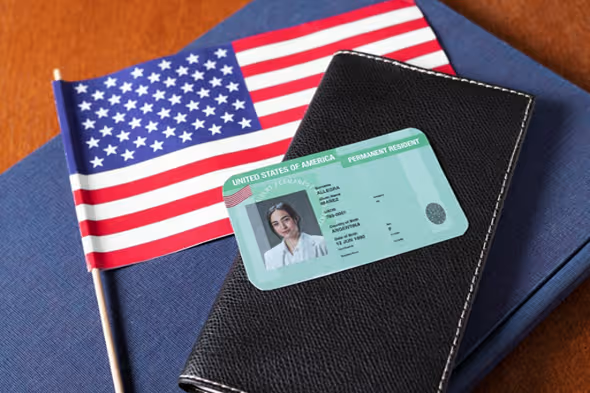
YA Green Card — officially a Permanent Resident Card — is the document that proves you have the right to live and work permanently in the United States.
There are two types, and the difference determines everything about your next filing: our Green Card (Form I-551) requires renewal under three main circumstances. Understanding which one applies to you is the first step toward a successful Form I-90 filing.
Standard Green Card: valid for 10 years, renewable. Most permanent residents hold this one.
Conditional Green Card: valid for exactly 2 years, issued when you obtained residence through a marriage less than two years old. It cannot be renewed — the conditions must be removed.
Green Card Expires: Look at the expiration date on the front of your card. If it is exactly 2 years after the issue date, you have a conditional card.
A standard Green Card is valid for 10 years from the date of issue. A conditional Green Card is valid for only 2 years.
Here is what most people don't know: your permanent resident STATUS does not expire when the card does. Only the physical card expires.
But without a valid card you cannot prove your right to work, renew a driver's license, or re-enter the United States after travel.
Your Green Card contains several numbers, and confusing them is one of the most common causes of filing errors and Requests for Evidence.
The card number changes with every new card. The receipt number is assigned to each individual application you file with USCIS.
Using the wrong number on a USCIS form is one of the most frequent causes of processing delays. If your card is lost or damaged and you cannot read these numbers, you will need a green card replacement.
As a permanent resident you can travel abroad freely, but there are rules that protect your status:
You must carry a valid Green Card to re-enter the United States. If yours has expired and you have already filed for renewal, your I-797 receipt notice extends your card's validity and serves as valid proof alongside the expired card.
If your card is expired and you have not filed yet, do it before you travel — renew your 10-year green card.
The cost depends on what you need to do — renew it, replace it, or remove conditions. Here are the real 2026 figures, with no hidden charges:
$415 online or $465 by paper in USCIS fees, plus our flat professional service fee. See the full green card renewal fee breakdown.
same USCIS fee structure, plus our service fee. See green card replacement.
$700 online or $750 by paper in USCIS fees, plus our service fee. See remove conditions on your green card.
Every service includes two payment plans: pay in full for 10% off, or split it 50/50. An immigration attorney typically charges two to three times our fee for the same administrative filing.
A fee waiver (Form I-912) may reduce or eliminate the USCIS fee if your household income is at or below 150% of the Federal Poverty Guidelines.
Not sure which applies to your case? Book a free validation appointment and we'll give you the exact numbers before you commit to anything.
A Green Card grants permanent residence. Citizenship grants full membership, including the right to vote and a U.S. passport.
The four differences that matter most:
Important: you must maintain a valid Green Card while your citizenship application is pending. If yours expires during the process, renew your 10-year green card before filing Form N-400.
Ready for the next step? See our citizenship and naturalization services.
Every service follows the same model: a free validation appointment before you pay anything, an assigned case manager, fixed pricing in writing, and real-time tracking until USCIS approves your case.


Choosing the wrong form is the most expensive mistake in the process —USCIS rejects the petition and you start over months later. Find your
situation below:
| Your situation | What you need | Your next step |
|---|---|---|
10-year card expires in 6 months |
Renewal (I-90) | |
10-year card already expired |
Renewal (I-90) | |
Card lost or misplaced |
Replacement | |
Card was stolen |
Replacement | |
Card damaged or unreadable |
Replacement | |
Name changed legally |
Replacement | |
Card has incorrect information |
Replacement | |
2-year conditional card |
Remove conditions | |
Divorced with conditional card |
Waiver — attorney |
See our note |
Every case at Quick Step is handled by a dedicated Immigration Case Manager — a document specialist trained in USCIS filing requirements,
not a chatbot and not a generic call center.
Your case manager reviews your forms personally, audits your evidence, and answers your questions from the free validation appointment to
your final approval.
We are not a law firm. If your case requires legal representation — criminal history, prior removal proceedings, or a waiver petition — we tell you honestly and recommend you consult an immigration attorney. We would rather lose a client than mishandle a case.
That is exactly what the free validation appointment is for. In 30 minutes, a professional case manager reviews your situation, confirms which form applies to your case, and tells you honestly whether we can help — before you pay anything.
✓ Free assessment (valued at $80) — no payment to book.
Renewal, replacement, or removal of conditions — choosing the wrong form means USCIS rejects your petition and you start over months later. In a 30-minute free validation appointment, a professional case manager confirms exactly which form applies to your case and tells you honestly
whether we can help, before you pay anything.

These are the questions our case managers hear most often — about numbers, timelines, travel and cost. Direct answers, with the 2026
figures you need.
A standard Green Card is valid for 10 years from the date of issue. A conditional Green Card, issued through a marriage less than two years old, is valid for exactly 2 years and cannot be renewed. Your permanent resident status does not expire when the card does — only the physical card.
The card number, also called the receipt number, is printed on the back of your Green Card. It is a 13-character code beginning with three letters that identify the USCIS service center that produced the card. It changes every time a new card is issued.
Your A-Number (Alien Registration Number) is your permanent identifier with USCIS and never changes, even when you replace your card or naturalize. The card number changes with every new card. The receipt number is assigned to each application you file.
The document number appears on the front of newer Green Cards. It identifies the physical document rather than your immigration record, and employers use it during I-9 employment verification.
It depends on the service. Renewal or replacement (Form I-90) costs $415 online or $465 by paper in USCIS fees. Removing conditions (Form I-751) costs $700 online or $750 by paper. Add a professional service fee if you use managed filing — ours is a flat rate with two payment plans, roughly half what an attorney charges.
Yes. Trips under 6 months have no impact on your status. Trips between 6 and 12 months may raise questions at re-entry. Trips over 12 months risk being treated as abandonment of residence unless you obtained a re-entry permit before leaving.
Only if you have already filed for renewal and carry your I-797 receipt notice, which extends your card's validity. Carrying the expired card
alone is not sufficient proof for re-entry.
A Green Card grants permanent residence and must be renewed every 10 years. Citizenship is permanent, grants voting rights and a U.S. passport, and cannot be lost through extended absence abroad. Citizenship requires 3 to 5 years of continuous residence plus English and civics tests.
A conditional Green Card is issued when you obtain permanent residence through a marriage that was less than two years old at approval. It is valid for exactly 2 years and cannot be renewed — you must file Form I-751 to remove the conditions during the 90 days before it expires.
For standard administrative filings, no — precision matters more than legal strategy, and professional case management costs about half of an attorney. You do need an attorney if your case involves a criminal record, prior removal proceedings, or a waiver petition.
Your permanent resident status remains intact — only the card expires. But without a valid card you cannot prove your right to work, renew a driver's license, or re-enter the country after travel. File Form I-90 as soon as possible.
Verify five things before paying anyone: they state clearly whether they are a law firm, they give fixed pricing in writing, they have a verifiable physical address and phone, they never guarantee approval or promise to speed up USCIS, and they never ask you to sign blank forms.